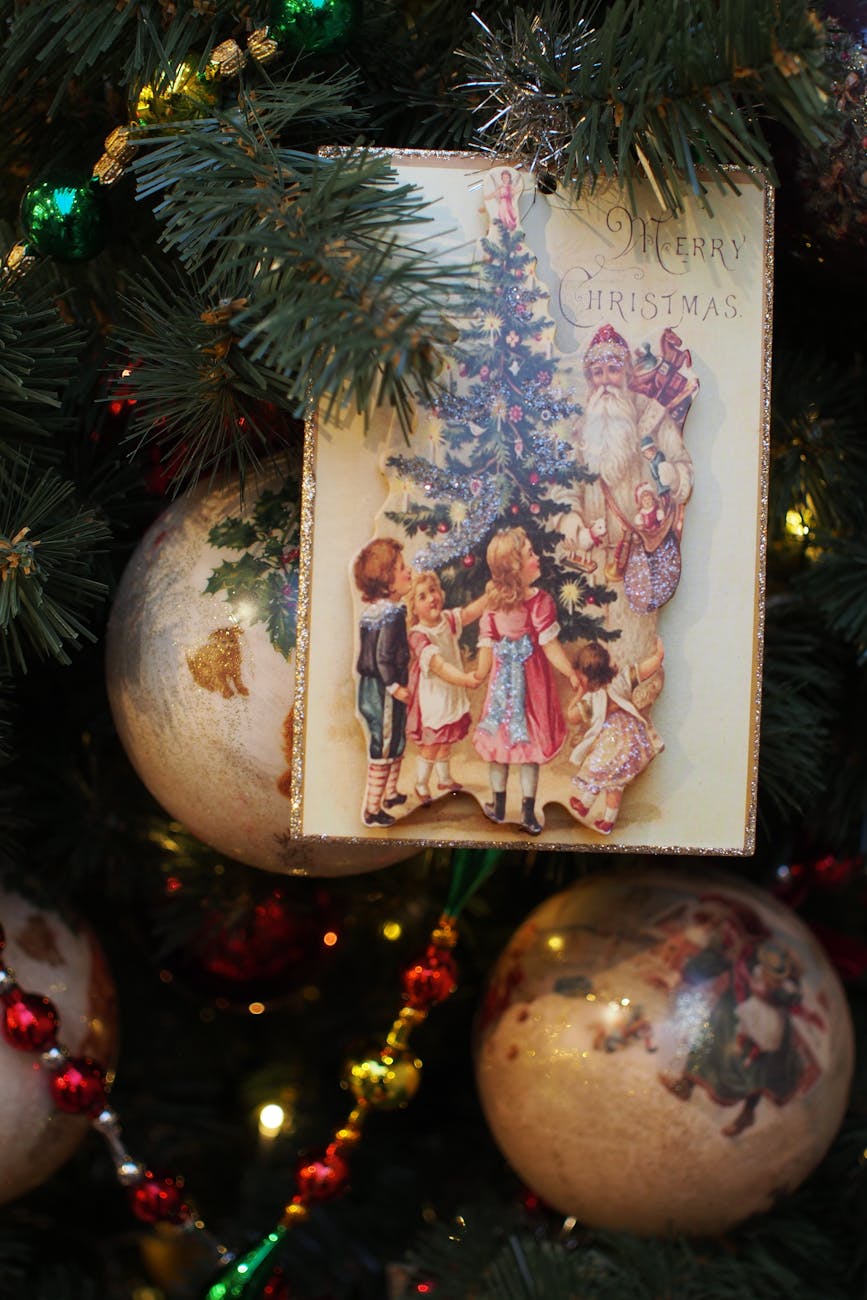
Now that Christmas is over once again, I thought this might be a safe time to discuss a topic which is a bit controversial amongst some parents – the topic of Santa. I’m sure you are all aware of the discussions which take place among children. Those who have been informed that “there is no Santa” are quick to pass that information along to their friends who do believe in Santa. All of this can be quite confusing to kids. But it isn’t just kids who are confused; a lot of parents don’t know how to handle the whole question of Santa. Plenty of voices are out there telling parents they should not allow their children to believe in Santa – that they may harm them spiritually and irrevocably if they do not tell them the “truth” about Santa. While most parents ignore the extraneous Santa noise out there and calmly go about their lives, including Santa in their Christmas festivities, others are understandably confused, not wanting to damage their children’s souls.
A few years ago, I had an interesting email discussion (argument, really) with a gentleman who sent out a monthly newsletter in which he provided instruction to men on how to be good husbands and fathers. So, of course, I (a wife and mother) immediately subscribed to his newsletter. (I was curious.) But when his Christmas email one year announced to fathers that they should not allow their children to believe in Santa Claus because Santa Claus was a lie, I will have to say that I was shocked.
A Lie?
Of course, I knew that many parents preferred to emphasize the birth of Christ and minimize the secular aspects of Christmas. Christmas is, after all, a religious holiday. But I was jarred by what this gentleman had said. Was Santa Claus actually a lie? If you allowed your children to believe in Santa, were you really lying to your children?
I thought back to my own childhood. I grew up believing in Santa. Christmas was a magical time for me. My parents were devout Christians and taught their children that Christmas was the celebration of Christ’s birth, but they also allowed us to believe in Santa. When I was a little girl, my father used to read a poem to me that described Santa’s reindeer tapping on the roof, and I would listen for the reindeer as the snow fell softly outside the window. I was sure I could hear them. My brothers and sister and I loved waiting to see what Santa brought us on Christmas morning. I had a few friends here and there who didn’t believe in Santa, but I ignored them. Santa was part of the magic of my childhood.
But eventually I grew up, and my husband and I had to decide how to handle the question of Santa with our own children. As I thought about this newsletter, I realized that as I had grown older, I had never confused the truths of Christianity with the magical aspects of my childhood. I was always able to separate the absolute truth of Christianity from the “fairy-tale” aspects of Christmas that I had grown up with, just as I was able to see the difference between the fairy tales of Cinderella or Pinocchio and the historical accounts of George Washington or Napoleon. And I decided that was the key.
What is Real?
So I emailed this gentleman in response to his newsletter. I expressed my view that Santa Claus is not a lie. Santa Claus is a fairy tale. Then I asked him:
When you read “Little Red Riding Hood” or another fairy tale to your child, do you begin by saying, “Now the story I am about to read is a lie?” Or do you assume that your child knows the difference?
Interestingly, when he responded to my email, I was not surprised, because I had already correctly guessed his response. He expressed that he did not believe in reading fairy tales to his children. He went on to say that he did not believe in reading stories that weren’t “real” to his children, such as stories with talking animals, because talking animals weren’t real. And he reiterated that we should not allow our children to believe in Santa, because Santa isn’t “real.”
I thought about that for a bit, because I had been reading some interesting Bible stories to my children just that week. I wrote him back and related the following:
This week I read my children a Bible story each day. In one of the stories, a snake talked. In another story, a donkey talked. And in a third story, a man was surrounded by invisible chariots and horses who were fighting a battle. And I believe that all of these stories from the Bible are true and that the characters are real.
And then I continued:
And the Bible teaches us that one day, the King will come to slay the dragon and rescue his Bride, and He will take her to His Kingdom where they will celebrate their marriage supper and live happily ever after. Because that is the story of Christianity. It is a fairy tale, but it is true, and it is the truest story of all.
This gentleman never responded to that email. But I continue to believe that Santa should be viewed as a fairy tale rather than a lie, and that children will not confuse a fairy tale character with our Savior.
Faith and Wonder
I totally understand that many parents want to focus on the true meaning of Christmas and de-emphasize the secular aspect. I have no qualms with that commendable desire. Christmas has become more and more secularized and commercialized. I simply object to the idea of labeling Santa Claus a lie.
I personally prefer to decorate traditionally, to give our Nativity creche a special spot, and not to have Santa Claus paraphernalia all over the house, as we want to emphasize the birth of Christ. However, we did allow our children to believe in Santa when they were young, and they loved getting up on Christmas morning and seeing what Santa had left them, just as my husband and I did as children. As they grew older, they did not confuse Santa with Christ or wonder whether Jesus was real. In fact, all of our children developed a strong Christian faith over the years and continue to be examples to my husband and me in our faith.
I suppose then we need to ask if it is a good idea for our children to read fairy tales. I say yes, but that is a subject for another day.
But remember, as J. R. R. Tolkien said in his essay On Fairy Stories, “The Gospels contain a fairy-story, or a story of a larger kind which embraces all the essence of fairy-stories…But this story has entered History.”
I would also encourage you to look up the original Santa Claus – Saint Nicholas, Bishop of Myra, whose feast day has historically been celebrated on December 6. His story is one worth reading.
 Ancient & New