Three Things My Mother Taught Me

My mother died recently, at the age of (almost) 96. She was not your typical mother. When other mothers were baking cookies, cleaning the house, or planting roses, she was reading theology books, running a monthly luncheon for Christian ladies, or setting up a museum. If I was late getting home from school for some reason, she didn’t even notice, because she would be on the phone coordinating events. My best friend’s mother would be panicking and on the point of calling the police if she was late, but not my mother. As a result, I had a lot of freedom as a child, because my mother did not micromanage my activities.

Even though she was a stay-at-home mom in the 50s and 60s, she was a far cry from the stereotypical “housewife” type. She was extremely analytical, so much so that when I used to watch murder mysteries with her on Sunday evening, she would engage in a running commentary the entire time, dissecting the characters and pointing out any moral lapses or ambiguities. She analyzed everything from a Christian perspective and was always ready to engage others in heated debate. She could be quite difficult and critical at times, thanks to her analytical brain, which was usually in overdrive. 

She was not really into food (with the exception of chocolate), and I’m sure the last thing she wanted to do every day was prepare dinner for her family, but she did it almost every day for 30 years or so, until all four of us children grew up. Sometimes there might be an under-abundance of the main dish, as she was not a big eater herself and had a hard time estimating how much food growing boys (my two brothers) would eat, but none of us starved to death. For that I am thankful.

Even though my mother was not the nurturing, bedtime-story-reading or cookie-baking type, she taught me quite a few important things over the course of my lifetime. Three stories especially come to mind when I think of her, stories which illustrate her legacy in my life.

Swim Team 101: aka, How to Fail

My mother taught me how to fail. Learning how to fail is an important part of life, and something many people don’t really learn how to do. I was good at a lot of things – schoolwork and piano, for example – but I was really bad at one thing, and that was swimming.

When we were young, our family lived in a neighborhood that included a swimming pool, and we could go to the pool all summer and swim. The pool also offered a swim team. My father used to tell us, “If I am going to pay the dues for you all to use the pool, then you are going to take advantage of every opportunity it offers, and that includes the swim team.” So we all had to swim on the swim team every summer. 

I hated it. I was 9 years old when I started, and I was SOOO slow. In my first swim meet, they had to fish me out before I got to the end of the pool because I think I started to drown. Even when I could make it to the end, I was so slow that I did not just come in last – I was half a length of the pool behind everyone else. But after every single swim meet, after I came in last, I would go over to my parents, and they would say, “Good job, honey.” And I would say, “But I came in last!” And my mother would say, “But that’s all right; you have a beautiful stroke!” And then she would usually make a comment along the lines of if the ship is sinking, it doesn’t matter how fast you swim, just that you can swim (which I’m not entirely sure is true).

Over the years, I got a little faster, but I was never actually fast. But my mother didn’t care how fast I was; she was much more impressed with my “beautiful” stroke. And I learned that even in my failure, there was something that I was good at – my stroke! And that we can’t all be good at everything, but we can look around for something positive in the things we are not so good at. My mother taught me how to fail.

Bugs in the Cereal: aka, How to Be Frugal

My mother also taught me how to be frugal. My mother was always very frugal, probably at least in part because she grew up during the Depression era. She did a lot of grocery shopping at the A&P (an ancient grocery store – I don’t know if it exists any longer) because it was cheaper. That is where she bought our cereal. But the problem with the cereal from the A&P was that in the summer, it had bugs in it. Little black bugs. And because of our father’s insistence that we all had to swim on the swim team, we had to get ourselves up every morning to go to swim team practice, which started at 8:30. And for breakfast, we ate cereal from the A&P. We had learned that the little black bugs in the cereal would just rise to the top after we poured in the milk, so we just spooned them off the top, ate our cereal, got on our bikes, and rode off to the neighborhood pool for swim team practice. Didn’t give it a second thought.

One day, my best friend spent the night with me. In the morning, I, of course, had to go to swim team practice. (My friend’s father did not make her swim on the swim team, for some reason that I could not understand.) So at breakfast, I began to offer her some cereal choices. “Would you rather have Bug Bran, Bug Flakes, or Sugar Frosted Bugs?” I asked. And she responded sheepishly with, “I think I’ll go home for breakfast.” I remember thinking to myself, “What a wimp.” Because after all, as our dad used to say, “A few bugs never hurt anyone.” That’s because he grew up spending his summers in the country on a farm and was not afraid of bugs. 

My mother’s frugality extended beyond bugs in the cereal. She taught me to always look for value; for example, instead of paying full price for an item, she would wait until the same item was 40% to 50% off, or maybe even 75% off the last marked down price, before she bought it. I don’t think she ever bought anything that wasn’t on sale, but she always had beautiful clothes and a beautiful home and made sure we all had nice clothes. She believed in value. And I learned about value and frugality from her.

The Butler’s Pantry: aka, How to Think

The third story that illustrates my mother’s legacy in my life has to do with our butler’s pantry. You see, when I was in high school, we lived in a house that had a butler’s pantry. Now, mind you, we did not have a butler. After all, we had been eating cereal with bugs in it from the A&P. But we did have a butler’s pantry. And not only did we have a butler’s pantry, but we also had a butler’s buzzer under the dining room table. So if we sat at the table and pushed our foot down on the exact spot where the butler’s buzzer was, we could hear the buzzer go off inside the butler’s pantry. We loved doing that. Even though a butler certainly never made his appearance.

Anyway, inside the butler’s pantry were cabinets for dishes and glasses, so the butler could serve people more easily. But my mother used those cabinets for her collection of theology books. She had lots of books in there (along with her stash of chocolate candy). And she knew right where each one was. One time I came home from college and said, “Mom, I have a professor in my Christian doctrine class who doesn’t believe in Hell.” (This strange new doctrine was contrary to what I had been taught all my life.) My mother did not faint, panic, or even skip a beat. Her reaction was, “Oh, I have a book about that.” And she pulled it right off a shelf in the butler’s pantry and gave it to me. Another time, I reported that the same professor did not believe that God had a plan for anyone’s life, or even a plan at all! Again, my mother did not hesitate; she just responded, “Oh, I have a book that deals with that issue,” pulled it straight off the shelf, and handed it to me. She often encouraged me to read Christian thinkers whose books she had on her shelf in the butler’s pantry. Even though they were well over my head, I persisted and eventually benefited from expanding my thinking and vocabulary. 

Even though she was notoriously difficult at times to have a conversation with because she loved to turn everything into an argument, I could ask her any question about theology or the Christian faith and she did not judge or criticize me. I learned from my mother that it was OK to ask questions about my faith and that Christianity could stand up to rigorous questioning. Consequently, when other people were jumping ship and abandoning their Christian faith because they were told not to ask questions but rather just to “have faith,” I had learned to search for answers and not to give up easily when confronted with difficulties that challenged my faith. Instead, my own faith was strengthened, largely due to the way my mother handled my questions.

And that ability of my mother to think analytically and to investigate theological issues was probably the main reason that I learned to read critically, analyze information, and educate myself about my faith as well as about educational and other topics. Other than her Christian faith itself, one of the most important legacies my mother left me is that she taught me how to think. And for that, I will always be grateful. My mother’s Christian values as well as her love for education eventually led me to classical education with its emphasis on teaching children how to think and reason. 

Some other random things my mother taught me:

How to Make Mud-Pies: Yes, she actually bought me a recipe book for mud pies, and I followed it assiduously, making mud pies in the backyard with dirt and kitchen utensils. I loved that mud-pie book, and it led right into making actual desserts, as well as other real food!

How to Read: She taught me my phonics sounds with flashcards when I was four and then gave me Chippy Chipmunk’s Adventures to read as my first book. I think it was 3rd grade level, and at the time, I thought it was so difficult, but I read it and have been reading ever since. She despised the Dick and Jane readers (that’s another story), hence Chippy Chipmunk’s Adventures. If anyone knows where a copy can be found, I would love to know.

How to Be Modest: My mother didn’t believe in girls wearing two-piece swimsuits because they were too close to bikinis, which she considered to be extremely immodest, so we wore one-piece swimsuits only. She also did not allow me to play with Barbie dolls; she thought they were too mature for little girls. I am grateful for her emphasis on modesty and tried to pass it on to my daughters.

The influence of a mother extends down through the generations. I am grateful for the influence my mother had on me as well as my children.

Enhancing Classical Education with Art Appreciation

One of the things that should be included in an enriched classical education is art appreciation. Exposing children to beautiful art is a wonderful way to put their souls in touch with truth, beauty, and goodness. And art knows no age limitations; young children, teenagers, and adults can all enjoy art together. I loved the fact that the original curriculum I chose for my children included art appreciation and even art history for older children. What are some ways that we can include art appreciation in a classical education?

In this post, I have listed a few ways we can easily share beautiful art with children. These are ideas we can use for all ages, so that young children as well as parents and teachers can enjoy the same art together.

Art Prints

As I was educating my children, I came across the ideas of Charlotte Mason, a British educator who had a gentle approach to classical education and believed in enriching children’s lives with the best art, music, and literature. She advocated using art prints with children, allowing the children to spend some time each week observing a painting, perhaps even attempting to imitate it by making their own copy. 

This method is easy to reproduce either in the classroom or with one’s own children and takes very little time. Some teachers follow this approach with a dedicated “Art of the Week” wall. And Memoria Press, for example, publishes a set of art prints for the lower grades with discussion suggestions for each print. They sell large art prints for a classroom wall as well as small prints so that each child can have his or her own set to hold, if desired. Children love to hold the art prints and pass them around, and they especially love to choose their favorites.

In my classroom of young children, we would sometimes make a craft that related to our art for that week, so one week, everyone painted a bowl of apples in honor of Van Gogh’s Still Life with Apples. Another time, we practiced our version of pointillism because we were learning about the artist who invented pointillism. 

Charlotte Mason recommended spending longer than a week on each art print, and I would agree with her. You can easily buy a set of art prints and use them for two years, stretching them out a little longer. And you are welcome to take the same set and repeat them later with older children, as the selection of art is completely arbitrary and totally up to you. The same art was created to be enjoyed by all ages, and we are free to pick and choose what we believe would be best for a particular class or child. Children love familiarity and enjoy seeing their favorites over and over.

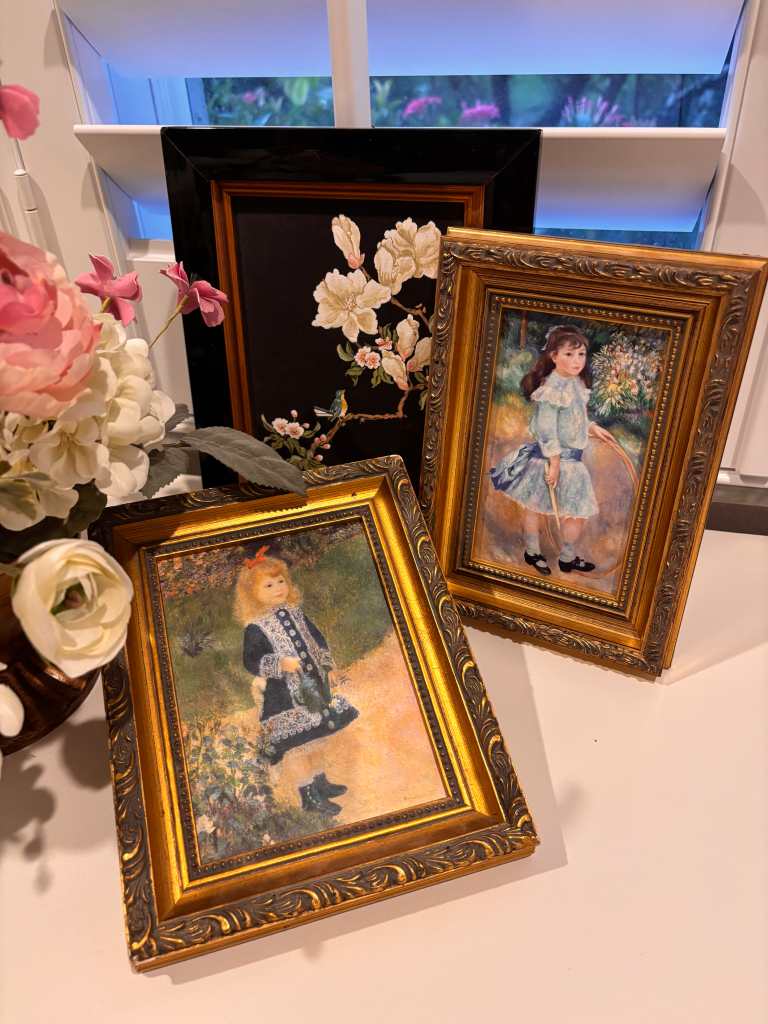
I used to hang framed art prints on my wall at home, and when my children saw the same prints in a book, they would get excited because they knew we had that same painting on our wall at home!

Integrating Art Prints into Other Subjects 

As children grow older, art appreciation can even be integrated into history and literature. The Calvert 4th grade world history course included a set of art prints that correlated with many major events and people of world history. When children read about ancient Egypt, they would look at a photo of Nefertiti’s sculpture or a print of ancient Egyptian hieroglyphics. When learning about the Middle Ages, they would enjoy a print of the Sistine Madonna as well as Da Vinci’s The Last Supper; and they would be introduced to John Trumbull’s Signing the Declaration of Independence once they arrived at American history.

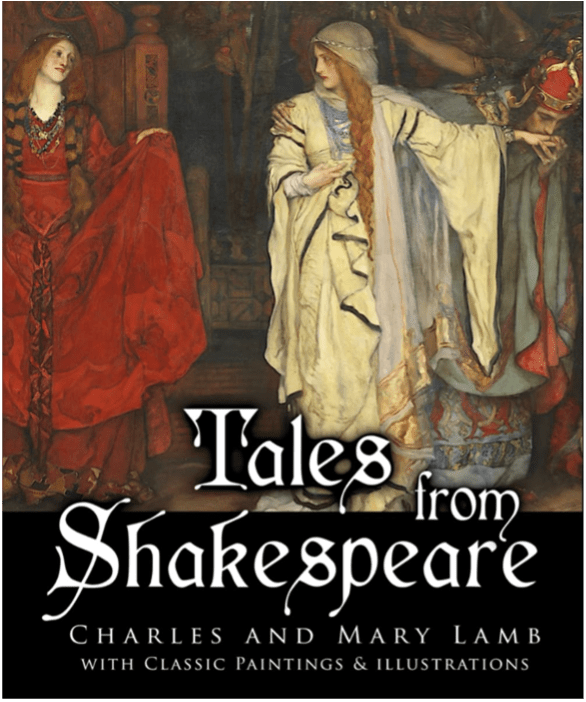
There are many works of art that correspond to literature as well; for example, quite a few artists have painted scenes or characters from Shakespeare. I recently bought a copy of Charles and Mary Lamb’s Tales from Shakespeare that includes numerous classic paintings corresponding to the plays in this volume. Any time you can find literature or history books that already include beautiful works of art, your children will benefit.

So don’t put away the art prints once children are in middle school or high school. Even adults benefit from them! Go ahead and post some of them in your classroom, perhaps some that go with the history or literature you are studying. 

Please note that as an Amazon Associate, I earn from qualifying purchases.

Books About Artists  

Enjoying art prints in the classroom or at home is only one way of acquainting children with beautiful art. Books about artists are another way to introduce children to art. Quite a few books about famous artists have been written for children, some for very young children that allow them to “touch” and “feel” the art. Here are a couple of examples, if you would like to look them up. (These are books for very young children).

Touch the Art: Make Van Gogh’s Bed

Touch the Art: Count Monet’s Lilies

Please note that as an Amazon Associate, I earn from qualifying purchases.

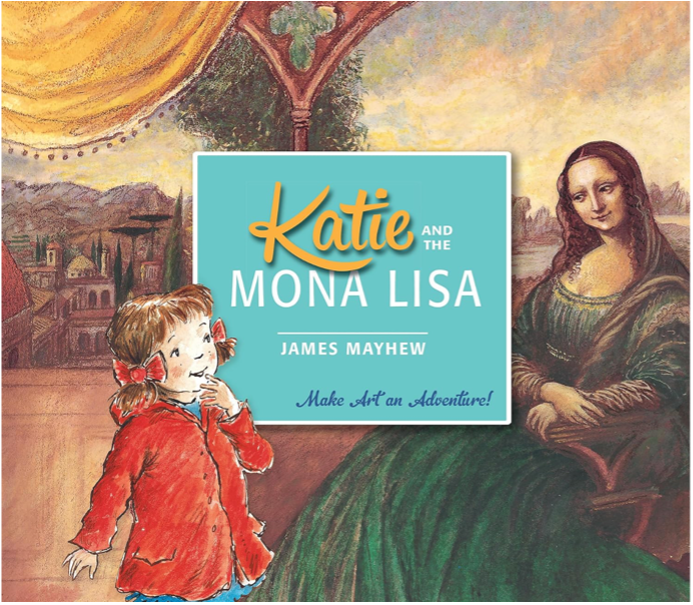
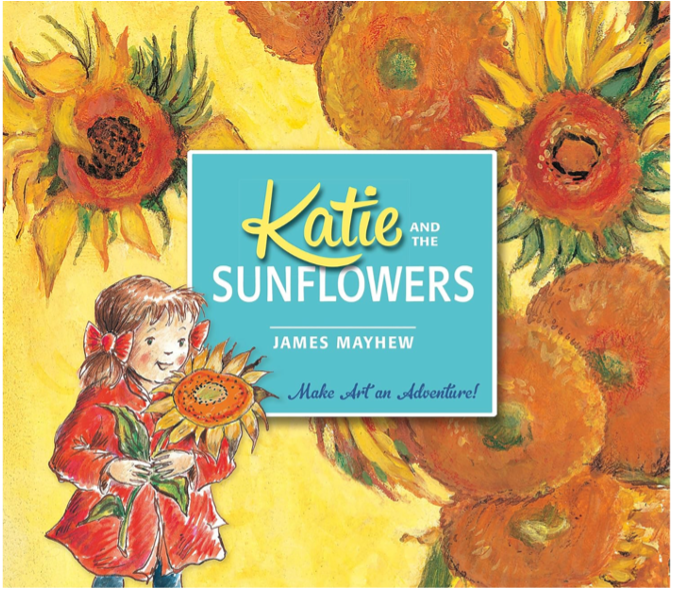
When my children were young, they loved the Katie series of books. I still have these books, as I’ve never been able to part with them. I’ve listed some of them below, if you would like to look them up. In the Katie books, Katie goes to the art museum with her grandmother and then hops right inside the paintings and runs around with the art characters while her grandmother dozes on the bench. After she finishes with her adventures, she and her grandmother go home together. These books are delightful, with beautiful illustrations, and children learn so much from them about famous artists and their art.

Katie and the Mona Lisa, by James Mayhew

Katie Meets the Impressionists, by James Mayhew

Katie and the Sunflowers, by James Mathew

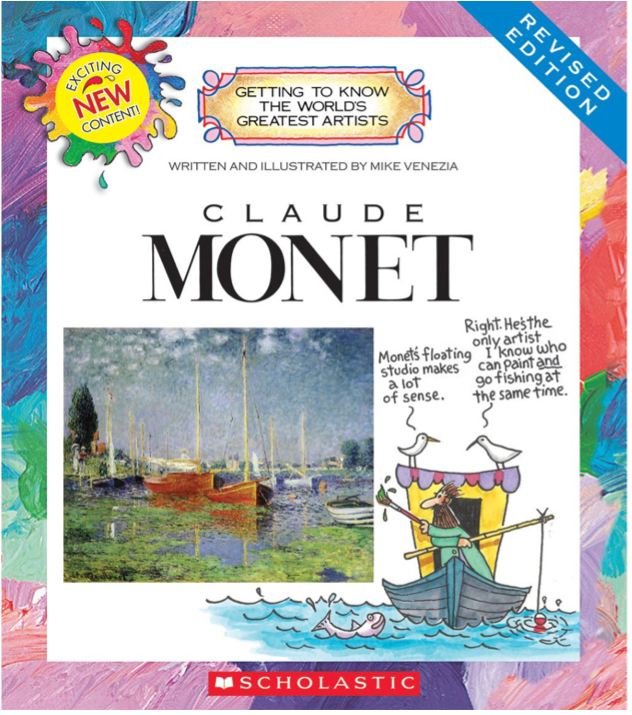
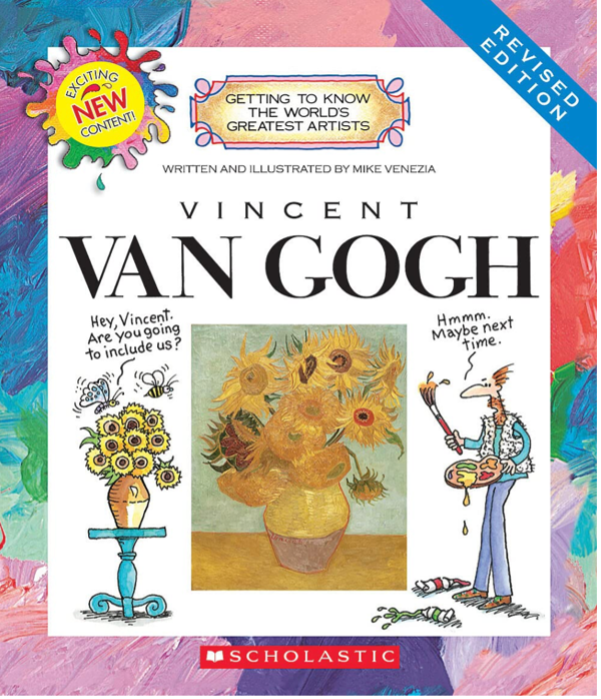
Older children (3rd – 6th grades) may enjoy the Getting to Know the World’s Greatest Artists series by Mike Venezia. His books are funny yet informative, and the reader tends to learn quite a lot about each artist. He includes information as well as cartoon commentary about each artist, along with examples of the artist’s work. My children loved these as well. I have listed a couple of them below:

Claude Monet, by Mike Venezia

Vincent Van Gogh, by Mike Venezia

Please note that as an Amazon Associate, I earn from qualifying purchases.

Books about Art History

Art history is a little different from art appreciation. In art history, children learn about the progression through history of different types of art, and as a result, develop a deeper and more mature understanding of painting, sculpture, and architecture. We used some older books that were written by Vergil Hillyer, the first headmaster of Calvert School, called A Child’s History of Art. They were designed to be used in middle school, for 5th, 6th, and 7th graders – one for each grade. I’ve listed them here, just in case you’d like to look them up, as they are out of print – A Child’s History of Art: Painting; A Child’s History of Art: Sculpture; A Child’s History of Art: Architecture               

We had so much fun with these books, learning about Greek columns in sculpture and flying buttresses in medieval architecture, and all kinds of things in between. However, there are many other books that can be used to teach art history, which you can find by perusing some of the classical Christian education catalogs.  

Artist Books

This third method is similar to the first and second methods, but in this case, you can just buy an entire book full of art prints, either of a particular artist or maybe a school of art. You can enjoy the book as is or you can pull the pages that you want to use out of the book and put them in a separate notebook or mount them on poster board, essentially creating your own art prints. This method can be a great way to collect the art you like, and some of these books are quite inexpensive.

Remember, have fun as you and your children engage with beautiful art!

More on Reading

In my first post on teaching reading, I provided a video to get you started with short vowel words – mainly words with three letters. 

In my next video, I will show you how you can introduce long vowels to your child. You will not want to do this until your child has had a lot of practice with short vowels and is comfortable reading sentences with short vowel words. 

I am listing some resources below that may come in handy for you and your child as you begin this adventure. They are all resources that I have used, both in a homeschool setting and in the classroom, and recommend highly.

Disclaimer: I have used all of the resources on this page and recommend them highly. I have used some of them in a homeschool setting and others in a classroom, and some in both. It is my desire to steer you towards high quality resources that will benefit you and make the task of teaching your child to read a pleasure, and that is my overarching purpose in listing these resources. However, please be advised that I do earn a small commission on any items that you purchase through the links on this page.

Classical Phonics, by Cheryl Lowe – This is an excellent resource which provides lists of words as explained in the video. (The book does not include sentences or stories.) This book is sold by Memoria Press, an excellent classical education publishing house.

Alphaphonics, by Samuel Blumenfeld – This book uses the same simple method, although it may progress a little quickly for young students. It has lists of words as well as many practice sentences. You can pick and choose which ones or how many you want to use. It is a classic, in my opinion.

Please note that as an Amazon Associate, I earn from qualifying purchases.

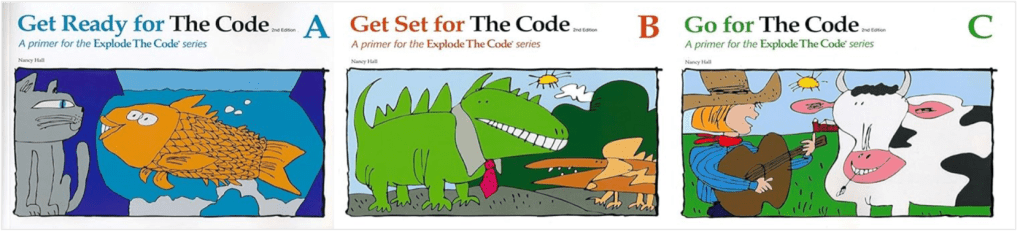
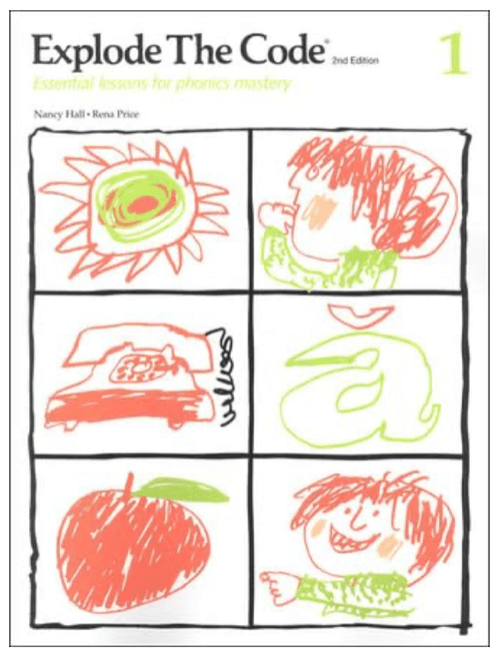
Explode the Code is an outstanding resource which includes a number of techniques to help your child learn to read, including visual discrimination, phonological awareness, and even handwriting and spelling.

The following three books are pre-reading resources in the Explode the Code series and will help prepare your child for reading: Get Ready for The Code A, Get Set for The Code B, Go for the Code C

Please note that as an Amazon Associate, I earn from qualifying purchases.

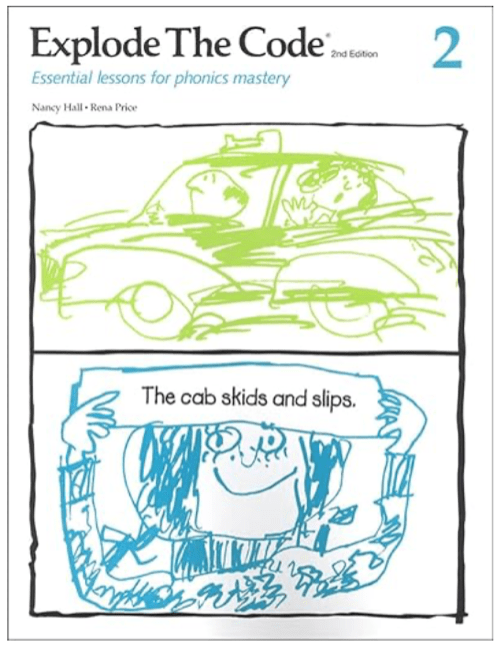
Explode the Code Books 1 and 2 are for learners who are ready to begin the reading process.

Explode the Code Book 1

Please note that as an Amazon Associate, I earn from qualifying purchases.

Explode the Code Book 2

Please note that as an Amazon Associate, I earn from qualifying purchases.

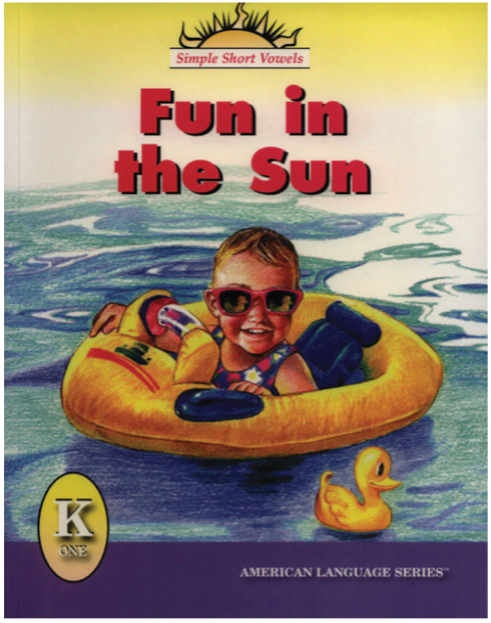
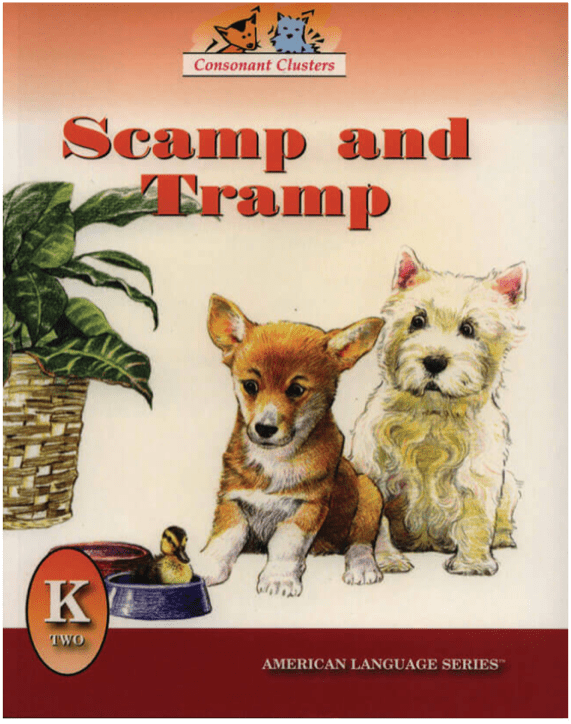
Beginning Readers: The following books are for beginning readers who are ready to read stories. They include stories composed mainly of short vowel words (CVC-consonant/vowel/consonant).

Fun in the Sun (sold by Memoria Press)

Scamp and Tramp (second book in the same beginning reading series, sold by Memoria Press)

In my next video, I will show you how you can introduce long vowels to your child. You will not want to do this until your child has had a lot of practice with short vowels and is comfortable reading sentences with short vowel words. Please enjoy the resources above until then!

My Life vs. Their (My Children’s) Lives

I popped over to my daughter’s house yesterday afternoon because my granddaughter (who is 7 years old) called me wanting to know how to sign in to “her phone” (my old phone). What was my daughter, who incidentally works full-time and has four children, doing when I arrived? She was going over my grandson’s schoolwork with him. He is in 5th grade, and she was helping him prepare for a grammar test and begin work for a research paper, in addition to reviewing his history and science. She also had to leave and do her grocery shopping for the week.

I helped my grandson with his grammar (I am kind of an expert at grammar) and then took three of the children to my house while my daughter did her grocery shopping. This morning, I started thinking about the fact that every time I go over to my daughter’s house, she is engaged in something productive – preparing a meal, washing the clothes, cleaning out her garage, organizing the clothes, etc. And on top of all that, she works during the week and spends a couple of hours each day dropping the children off at their various schools and picking them up. Her work is never-ending, and I have great admiration for her.

My life was so much easier when I was bringing up my children. I sent my oldest to kindergarten, but after that, I decided to homeschool her. Four more children followed, and I homeschooled them all for varying amounts of time. I loved homeschooling – loved researching materials, creating schedules, working with my children, and I loved the flexibility. I think my children benefited also, as they have told me that I taught them how to think. They were able to pursue their own interests in more depth and had more free time because they weren’t in school all day. And one of the nicest things about it is that I did not have to spend my time driving children to school or picking them up. I did not have an outside career or job for years. Life was simple and I loved it. But my now-grown children have their own interests and life plans, and they are all doing an excellent job rearing their children in the way that works best for their families. I am in awe of them, but I am so grateful that I was able to be at home with my children and educate them.