What I Learned When I Started Homeschooling

I mentioned in my first post about classical education that I originally chose the curriculum from Calvert School to use with my children. I’m sure many of you have never heard of Calvert School, as their homeschooling program does not exist any longer. When I began homeschooling, there were not many resources for teaching children at home. Curriculum packages were available from a couple of evangelical Christian publishing houses, but after I looked at the available materials, I was disappointed. Then I looked at Calvert School. I had heard of it because before homeschooling was a “thing,” Calvert School had developed a home education program which was primarily used by missionaries and diplomats who lived overseas, as well as by children who were too ill to attend school. This program had a “flavor” which I loved.

Calvert’s focus at this time was on the history and culture of Western civilization, and they included classic stories in both history and literature which ensured that children were introduced to many of these famous characters and legends (William Tell, King Canute, Xerxes, Alexander the Great, for example). I was impressed that Calvert introduced these stories to children when they were young and thus, when they would read about them later in their schooling, they would not be meeting them for the first time. Calvert also included stories of historical people who turned to Christianity from paganism, stories which I learned about for the first time when using Calvert. Even though the curriculum was not specifically Christian, per se, the stories of Christian heroes were allowed to speak for themselves. In Calvert’s original Kindergarten program, Christian hymns were even included on the music tape that we listened to when we sang along.

A Child’s History of the World

My favorite thing about the Calvert curriculum was the history book that was used in their 4thgrade course: A Child’s History of the World, written by the first headmaster of Calvert School, Virgil Hillyer. This book was a masterpiece, in my opinion. Students in the 4th grade home education program would be guided through the entire history of the world in one year, and other than the first two chapters of the book, which were a bit evolutionary, it was a delightful introduction to world history. Each chapter was written like a charming story – sometimes more like a fairy tale – and there were no questions or assignments in the actual book. A child who used the book as Calvert intended would be amazingly well-versed in world history at a surprisingly young age and would be well-prepared for high school studies. (I learned an astonishing amount of world history myself while studying it with my children and decided as a result that one of the best ways for adults to learn history is by reading children’s books on the topic – but that is a topic for another day.)

Classical Yet Gentle; Academically Excellent

The emphasis on the history and culture of Western civilization, even to the point of including art appreciation and music appreciation materials; the emphasis on writing compositions (which began in 3rd grade); and the strong academic focus of the curriculum were aspects that contributed to the classical flavor of Calvert School, even though at the time I did not know what classical education was. I could see, however, that this type of education differed from the traditional flavor of education provided by the evangelical Christian publishers whose materials I had looked at and even tried. I loved the fact that when my daughter read a story in A Child’s History of the World, that she would be asked simply to narrate the story back to me orally. Then we were instructed to make vocabulary cards for each story with a few specific words and dates included. At the end of each week, we would review these words and dates, including the preceding words that we had done. Because of this constant review, by the end of the year, my daughter remembered most of the vocabulary and dates from the entire year!

Calvert included basically no busywork. After reading a selection in literature or history, children could answer questions orally or narrate back what they had read. They typically did not have to answer numerous questions in writing. Writing was handled by planning and writing compositions on a regular basis. The compositions were on different topics, but my children often chose to write theirs on the history stories they were reading, which helped to cement the stories in their memory.

I recently looked up Calvert School and found that they no longer have a home education program. The private school still exists in Baltimore, but I believe their home education program has been sold. Modern homeschooling has resulted in a plethora of materials and has blessed many of us, but I am grateful that I was able to use Calvert materials while they were still around. I learned many things about teaching my children from their teacher’s manuals, which were invaluable. Those manuals were very detailed and guided the instructor (usually mom) so that no time was wasted, no busywork was included, and everything was well reviewed. From those manuals, I learned that homeschooling should not take more than 3 to 4 hours a day; I learned how to review using vocabulary; I learned the importance of narration, whether oral or written; and I learned how to provide my children with a strong academic foundation in a reasonable amount of time. I learned a lot about classical education without realizing it.

What Now?

The question now is: How can we provide this type of education to our children using the materials that are out there? Is there a similar program available today? Stay tuned for more.
Athens and Sparta

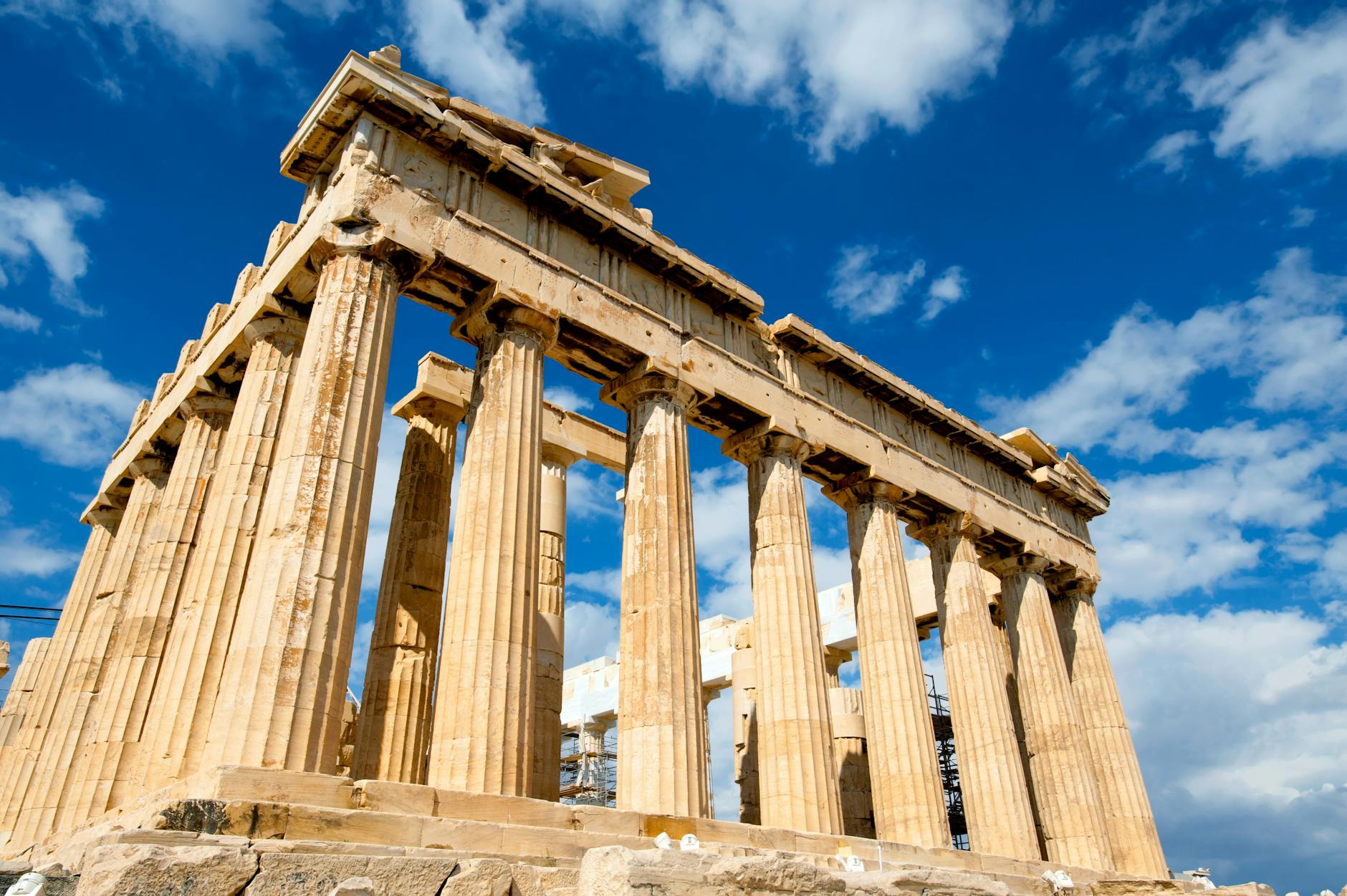
If we are going to talk about ancient Greece, we need to talk about Athens and Sparta because they were the most important cities in ancient Greece for years and years. Athens and Sparta were both founded many years before Christ (BC), but they were very different. The people in Athens loved beautiful things – beautiful buildings, beautiful statues, beautiful pottery, as well as beautiful ideas. You can still see some of their buildings today if you go to the modern city of Athens, which I have done. One of their oldest buildings which is still standing today is a temple called the Parthenon (Par-the-non), which they built in honor of the Greek goddess of wisdom, Athena. The Parthenon was a very important building because Athena was their main goddess, and they had named their city, Athens, after her. They put a very large statue of Athena in this temple – it was 40 feet tall, which is as tall as seven tall men standing on each other’s heads! Try to imagine that!

The Parthenon in Athens, Greece

Anyway, this statue is no longer standing in the original Parthenon in Athens, but if you want to see what it looked like, you might try visiting the replica of the Parthenon in Nashville, Tennessee. But even though the Parthenon in Athens, Greece is so old that it is crumbling and falling apart, it is still considered by many to be one of the most beautiful buildings in the world. The Parthenon stands on a hill called the Acropolis (a-crop-o-lis) along with a few other very lovely buildings which are also crumbling.

Athens flourished and prospered during a period of time call the Golden Age of Greece, from about 480 BC – 404 BC. (BC stands for “before Christ.”) A man named Pericles (pear-a-klees) was the ruler of Athens during its golden age, and he is still famous today because he did such a good job governing Athens during this time. 

Even though the Athenians loved art, beauty, and ideas, they also believed it was important to have strong bodies and to exercise. They had gymnasiums in the city of Athens so that the men could gather, have conversations, and practice wrestling and running. The people of Athens believed in being what we call today “well-rounded.” 

Now Sparta was quite a long way from Athens and had a completely different culture. A man named Lycurgus (lie-kér-gus) was the leader of Sparta, but his ideas were very different from those of Pericles in Athens. Lycurgus believed the most important thing was to be strong and to be ready to fight, so he made some rules that everyone in Sparta had to follow. As you read these rules, think about whether you would have liked them.

All babies, when they were born, were allowed to live only if they were healthy and strong. If they were sickly, they were left on a mountainside to die. Then, when little boys had their 7th birthday, they had to leave their mothers and go live in another place, sort of like a camp. In this “camp,” they were taught how to get along without enough food and how to go on long hikes in cold weather with only a thin coat. They were not allowed to sleep in soft beds, and they were even whipped from time to time for no reason other than to teach them to accept harsh punishments without complaint. All Spartan boys had to learn to be good soldiers. 

The Spartans did not believe in spending their time making beautiful things or having lengthy discussions about ideas. In fact, the Spartans believed that the fewer words one used, the better. They were so good at saying things in just a few words that they became famous for speaking in a “laconic” way, because Sparta was in the part of Greece known as Laconia. One time a general who wanted to conquer Sparta sent a long message threatening to turn them out if he invaded. Do you know what answer the Spartans sent in reply? They sent a message with one word: “IF”. We still say that someone is speaking in a “laconic” way if he or she replies with few words.

Every four years the Greeks held their Olympic Games, which were begun in Greece 776 years before Christ (776 BC). Both Athens and Sparta sent men to compete in the games. Which city do you think took more prizes over the years? You’re right; Sparta! Interestingly, the Spartans were especially good at chariot races!

You have already read about the Peloponnesian Wars, which unfortunately brought the Golden Age of Greece to an end.

Words to remember: Athens, Sparta, Pericles, Parthenon, Lycurgus, laconic

The Ancient Greeks

LATEST STORIES

The Peloponnesian Wars

The Peloponnesian Wars (431-404 BC)

The ancient Greeks were a little bit like you and your brother and sister (or your best friend). They didn’t always get along. One time the Greeks in Athens and the Greeks in Sparta got mad at each other about something that seemed very important at the time. So they went to war. And they didn’t fight just one war. They fought two of them! Can you guess how long these wars lasted? 27 years!

These wars were called the Peloponnesian Wars because they were fought in the part of Greece called the Peloponnesus. It is easier to say if you break it up into two words: Pelopon Nesus.

The Spartans were better at fighting on land, and the Athenians were better at fighting on the sea, because Athens governed many islands which paid “tribute” or taxes, to Athens. But Sparta had to keep stopping to check on their slaves, and Athens had an outbreak of the plague which killed thousands of people, including Pericles, who had been the most important leader of Athens during its Golden Age.

Then a man named Lysander became the new Spartan general. Lysander figured out a way to defeat the Athenian navy and actually won a naval victory against the Athenians. Over 150 Athenian ships were destroyed in this battle, causing Athens to surrender to Sparta.

A man named Thucydides (Thoo-sid-i-dees), who was a general in the Athenian army, wrote a book about the Peloponnesian Wars called The History of the Peloponnesian War. His book is the main reason we know what happened. After Sparta defeated Athens, Greece was never the same. As a result, a man named Alexander was able to conquer Greece. We will talk about him later.

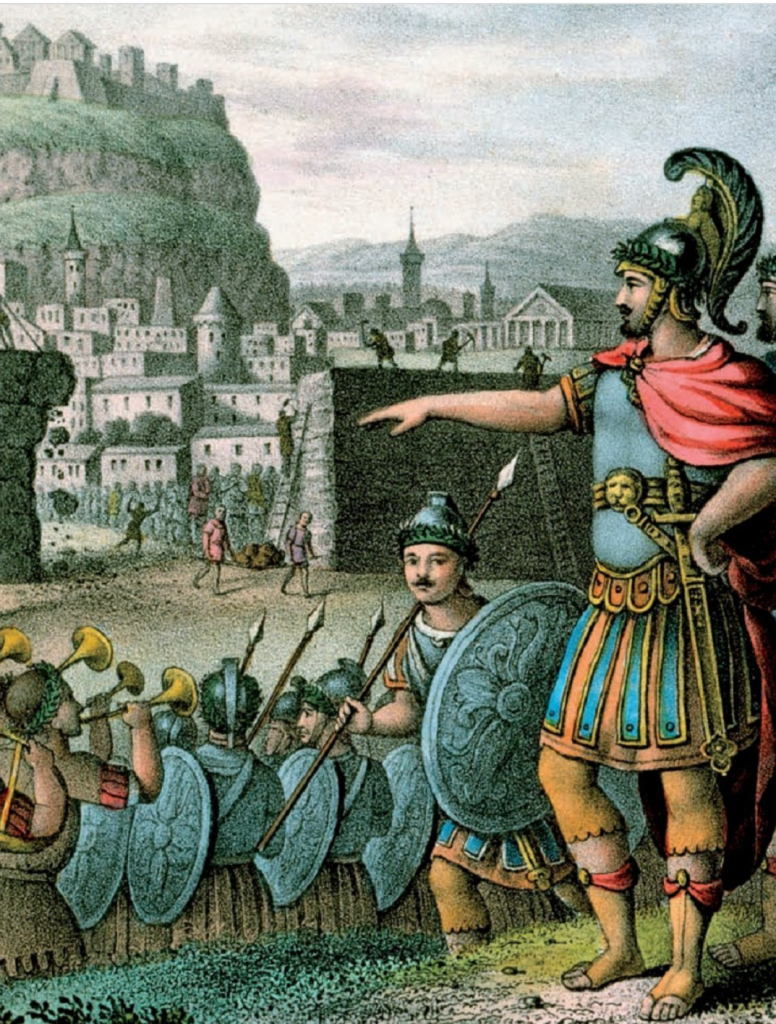
Lysander outside the walls of Athens; 19th century lithograph

I plan to add a story of the week below, suitable for all ages, so that we can learn the history of the world together, something which is essential for a classical education.