If we are going to talk about ancient Greece, we need to talk about Athens and Sparta because they were the most important cities in ancient Greece for years and years. Athens and Sparta were both founded many years before Christ (BC), but they were very different. The people in Athens loved beautiful things – beautiful buildings, beautiful statues, beautiful pottery, as well as beautiful ideas. You can still see some of their buildings today if you go to the modern city of Athens, which I have done. One of their oldest buildings which is still standing today is a temple called the Parthenon (Par-the-non), which they built in honor of the Greek goddess of wisdom, Athena. The Parthenon was a very important building because Athena was their main goddess, and they had named their city, Athens, after her. They put a very large statue of Athena in this temple – it was 40 feet tall, which is as tall as seven tall men standing on each other’s heads! Try to imagine that!
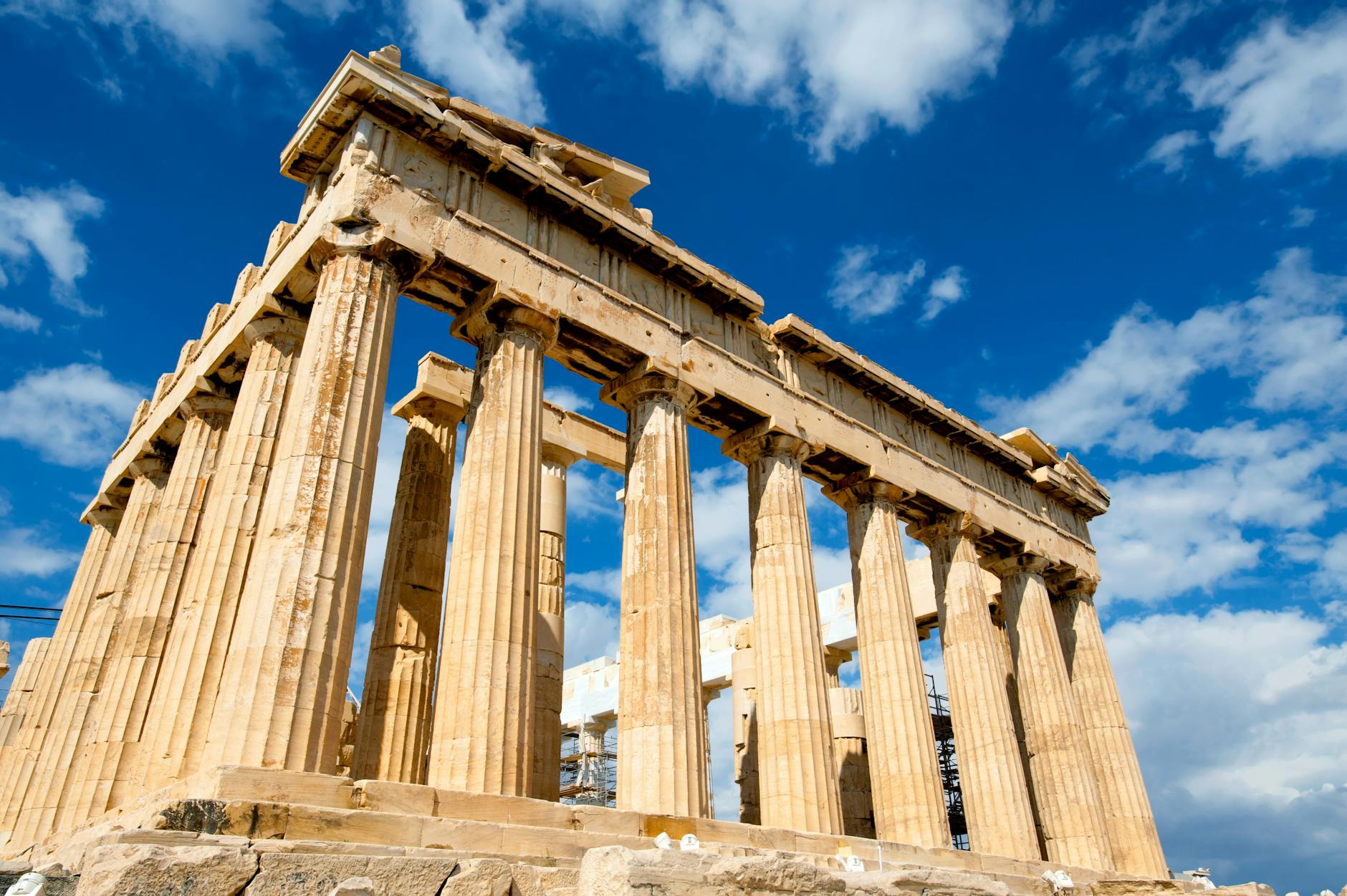
Anyway, this statue is no longer standing in the original Parthenon in Athens, but if you want to see what it looked like, you might try visiting the replica of the Parthenon in Nashville, Tennessee. But even though the Parthenon in Athens, Greece is so old that it is crumbling and falling apart, it is still considered by many to be one of the most beautiful buildings in the world. The Parthenon stands on a hill called the Acropolis (a-crop-o-lis) along with a few other very lovely buildings which are also crumbling.
Athens flourished and prospered during a period of time call the Golden Age of Greece, from about 480 BC – 404 BC. (BC stands for “before Christ.”) A man named Pericles (pear-a-klees) was the ruler of Athens during its golden age, and he is still famous today because he did such a good job governing Athens during this time.
Even though the Athenians loved art, beauty, and ideas, they also believed it was important to have strong bodies and to exercise. They had gymnasiums in the city of Athens so that the men could gather, have conversations, and practice wrestling and running. The people of Athens believed in being what we call today “well-rounded.”
Now Sparta was quite a long way from Athens and had a completely different culture. A man named Lycurgus (lie-kér-gus) was the leader of Sparta, but his ideas were very different from those of Pericles in Athens. Lycurgus believed the most important thing was to be strong and to be ready to fight, so he made some rules that everyone in Sparta had to follow. As you read these rules, think about whether you would have liked them.

All babies, when they were born, were allowed to live only if they were healthy and strong. If they were sickly, they were left on a mountainside to die. Then, when little boys had their 7th birthday, they had to leave their mothers and go live in another place, sort of like a camp. In this “camp,” they were taught how to get along without enough food and how to go on long hikes in cold weather with only a thin coat. They were not allowed to sleep in soft beds, and they were even whipped from time to time for no reason other than to teach them to accept harsh punishments without complaint. All Spartan boys had to learn to be good soldiers.
The Spartans did not believe in spending their time making beautiful things or having lengthy discussions about ideas. In fact, the Spartans believed that the fewer words one used, the better. They were so good at saying things in just a few words that they became famous for speaking in a “laconic” way, because Sparta was in the part of Greece known as Laconia. One time a general who wanted to conquer Sparta sent a long message threatening to turn them out if he invaded. Do you know what answer the Spartans sent in reply? They sent a message with one word: “IF”. We still say that someone is speaking in a “laconic” way if he or she replies with few words.
Every four years the Greeks held their Olympic Games, which were begun in Greece 776 years before Christ (776 BC). Both Athens and Sparta sent men to compete in the games. Which city do you think took more prizes over the years? You’re right; Sparta! Interestingly, the Spartans were especially good at chariot races!
You have already read about the Peloponnesian Wars, which unfortunately brought the Golden Age of Greece to an end.
Words to remember: Athens, Sparta, Pericles, Parthenon, Lycurgus, laconic







 Ancient & New